Murphy’s failed ransom handoff and arrest
The Mystery of The Invisible DogMurphy’s failed ransom handoff and arrest turns a public park’s waste-paper bin into a trap: the parcel is collected by a disguised man, yet Jupiter Jones recognizes that the supposed hospital patient can be both the thief and the man with a seemingly perfect alibi. The episode resolves the mystery through the precise timing of the demand, the physical trace on the package, and the contradiction between John Murphy’s bedside appearance and the clothes he wore to collect it.
The demand and the decoy
An unsigned, typed letter arrives in Fenton Prentice’s mailbox. Its instructions specify a brown-paper parcel of money in the waste-paper bin at the entrance to the park, at exactly five that afternoon. The letter is on plain white bond, and its envelope bears the previous day’s postmark. The exact place and hour turn the ransom into more than a demand: they provide Jupiter Jones with a testable arrangement, and the earlier postmark shows the instructions were already in circulation before their delivery.
Jupiter Jones prepares a false payment rather than exposing genuine money. Fenton Prentice helps locate brown paper, while Jupiter treats clipped newspaper dollars with investigative ointment, wraps the bogus ransom, and applies more ointment to the parcel’s exterior. The decoy is designed to leave a trace on whoever handles it. Its apparent value draws the collector into a conspicuous sequence of actions, while the treatment gives the investigators a way to follow the package even if the collector tries to dispose of it.
The park handoff
At nearly five, Fenton Prentice carries the parcel to the park entrance. The waste-paper bin is already almost overflowing. He looks around, puts the package inside, and walks back up the street. That simple deposit fulfills the letter’s instructions exactly, but the scene is not left unattended: a news vendor counts papers nearby, and a maintenance man is examining something on the grass.
A ragged man then rounds the corner from Wilshire. His coat collar is pulled up; he has no shirt, and one trouser cuff is torn. The disguise makes him look like a derelict rather than someone arriving to collect a ransom. He pokes into the bin and, within a second, has the brown parcel in his hands, hidden beneath his coat. The news vendor and maintenance man run after him. The quick recovery converts the carefully planted parcel into an apparent theft in public, but it does not lead Jupiter Jones to treat the pursuit as the end of the case.
When the policemen are ready to hurry after the collector, Jupiter Jones stops them. He says he knows where the burglar and the bogus ransom are, and that the man will not try to hide because he has a perfect alibi. The claim redirects the investigation from the ragged figure’s escape through the park to the place where an apparently respectable suspect is already expected to be: the Belvedere Medical Clinic.
The hospital-room reversal
Jupiter Jones goes directly to the large corner room occupied by John Murphy. Murphy is in bed with the covers drawn to his chin, watching television. Rather than searching the patient’s clothing or accepting the bed as proof of his whereabouts, Jupiter asks whether the package is in the closet or under the bedclothes. He opens the closet and finds the wrapped parcel, still sealed. The handoff has therefore led not to an unknown hiding place but back to Murphy’s room.
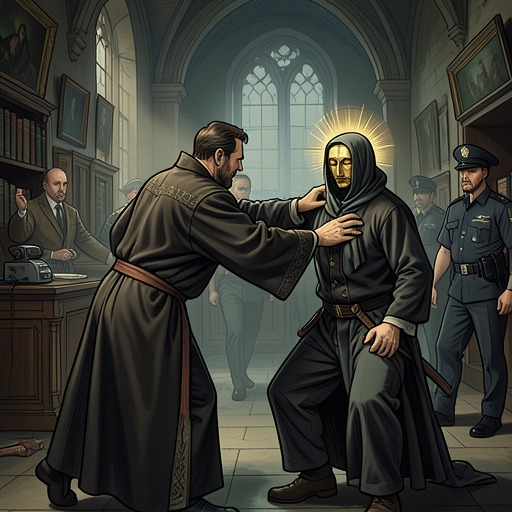
Jupiter Jones explains that the parcel was treated with special ointment and that Murphy’s hands will soon be covered with black spots. Murphy looks down at his hands. The marked package is the physical link between the park collector and the man in bed; it makes the disguise and the alibi answerable to the same evidence. Sergeant Henderson steps forward to tell Murphy his rights. Murphy says he knows them, asks to get dressed, and wants to call his lawyer. The scene’s reversal is immediate: the patient who seemed safely separated from the park by a hospital bed is now the suspect confronted with the stolen parcel in his own room.
The clinic had helped make the alibi plausible. When Jupiter Jones first visited, Murphy occupied a big corner room with sunlight coming through two windows, and Harley Johnson sat in an armchair at the foot of the bed. The private institution was described as elegant beside Central Hospital; it was a credible place for a person thought to be recovering to remain out of sight. Yet the setting’s apparent security depended on assumptions about a patient’s incapacity and the staff’s attention, not on proof that Murphy could not leave.
The alibi exposed and the motive
Jupiter Jones explains that Murphy had set the fire in his own apartment to give himself a reason to be hospitalized. He knew that few patients would be at the clinic between Christmas and New Year, and he was not seriously injured. After learning the nurses’ routines, he could slip in and out while they were not watching closely, since they wanted him to sleep. His bed and the staged injury were thus parts of a constructed alibi, not evidence that he could not have been the park collector. The ragged clothes complete the disguise in the handoff scene; the parcel in the closet and the ointment complete the chain back to Murphy.
The timing of the ransom letter had also helped identify him. Jupiter Jones later explains that the five o’clock delivery conflicted with Alex Hassell’s established cat-feeding routine: if Hassell had been the burglar, an absence at that hour would have been noticed. The demand’s seemingly arbitrary precision therefore excludes a suspect whose ordinary obligation made that time conspicuous. It is a clue built from routine rather than from a dramatic physical trace, and it complements the ointment that identifies the collector after the event.
The arrest exposes a financial motive rooted in Murphy’s guardianship of Harley Johnson. Murphy had borrowed money from Harley’s account to speculate on the stock market and lost it. Harley would come of age the following month, when Murphy would have to explain the missing funds. He needed ten thousand dollars to put back into the account before that reckoning. The ransom attempt was consequently an effort to cover losses created by Murphy’s own financial decisions, using a burglary and staged hospitalization to delay their discovery. The failed handoff brings the disguise, the false injury, the marked parcel, and the concealed financial breach into one case; a plan built on separation between the man in bed and the thief in the park collapses when the evidence reconnects them.